
“We’re using machines to sound like humans, and now the machines are frustrated. They want to remind us that we sound exactly like a million other people. We built the Land of Beige.”
End of the Beginning.
(No, I don’t just love Djo a lot.)
The year is 2022. Times are simpler. Everyone has 15 browser tabs open for in-depth research. Things aren’t so exhausting and dystopian. People still sound different, almost unique. They haven’t yet lost their voices to the digital abyss of buzzwords. Even though creating something from scratch is difficult, people still seem to have personalities. The editing process haunts them for hours, sometimes days. Their ideas and content bleed from reality into their dreams. By the time every word, comma, semicolon, and full stop is in its rightful place, they’ve practically completed a minor in their subject.
But there are still five unspoken rounds of editing left before someone finally realizes it’s time to let go. Nupe. Self-doubt creeps in so quietly that it ushers in a sixth round. By the time the writer finishes revising, they’re convinced they’ve created absolute garbage. It’s officially time to hydrate, touch grass, and return to reality. Four hours later, the post is published and released into the universe. At that point, there’s nothing left to control. The work belongs to the world now.

But there are still five unspoken rounds of editing left before someone realizes it’s time to let go. Nupe. Self-doubt creeps in so quietly that it ushers in a sixth round. By the time the writer finishes revising, they’re convinced they’ve created complete garbage. It’s officially time to hydrate, touch grass, and return to reality.
Four hours later, the post is published and released into the universe. From that moment on, it no longer belongs to them. The work is out in the world, and all they can do is let it find its audience.
Someone was cooking. Somewhere.
But let’s not be so quick to assume the times were that simple. Let’s rewind for a moment.
Before the explosive arrival of generative AI tools like ChatGPT (November 30, 2022) and Claude (public launch in 2023), people around the world were already using AI-assisted writing tools such as Grammarly (2009), Hemingway (2013), ProWritingAid (2013), QuillBot (2017), and Wordtune (2020). There were at least half a dozen more because humans have always loved a Russian roulette of choices. I’m not listing every single one because curiosity is a wonderful habit to cultivate.

These tools improved writing in several ways. They provided instant feedback on grammar, punctuation, and style, helping students strengthen their vocabulary, improve sentence flow, and develop clearer arguments. Over time, regular use also helped many students build stronger writing habits and greater confidence. Writing became less intimidating, particularly for learners who struggled with organizing ideas, maintaining a consistent message, or spending hours editing drafts. More importantly, these tools encouraged academic independence by allowing students to learn and improve at their own pace.
(The academic research supporting these educational outcomes can be found here.)
Educators also benefited from it. Instead of spending large amounts of time correcting grammar and sentence structure, teachers could focus on higher-value aspects of learning, such as developing critical thinking, strengthening arguments, creating lesson plans, designing assessments, and providing personalized guidance. AI-assisted writing tools acted as teaching aids rather than replacements, giving educators more time to support students where human expertise mattered most.
Outside classrooms, professionals adopted these tools for a different reason: efficiency. AI-assisted writing simplified drafting emails, outlines, reports, and social media content, while also helping with editing, summarizing research, and brainstorming ideas. By automating repetitive writing tasks, these tools freed people to spend more time on strategy, creativity, and decision-making.

Before we disappear into an existential spiral over the phrase “AI-assisted,” let’s clear something up.
Generative AI and Assistive AI are two different types of artificial intelligence. I didn’t know the difference either until I researched this article. It’s okay not to know everything.
Artificial intelligence (AI) is the broad field that enables computers and other machines to perform tasks we usually associate with human intelligence, such as learning, reasoning, recognizing patterns, solving problems, making decisions, and creating new things. Depending on how they’re designed, AI systems can follow predefined rules, learn from examples, adapt over time, and improve as they process more information.
Although AI has existed for decades, the term “artificial intelligence” was first introduced in 1956. By the 1960s, the U.S. Department of Defense had already begun exploring ways to train computers to mimic aspects of human reasoning.

Generative AI is a type of artificial intelligence that creates new content from scratch, including text, images, code, audio, and video. Many popular generative AI tools, such as ChatGPT, Claude, Gemini, Midjourney, Stable Diffusion, Runway, Suno, and ElevenLabs, are built on different AI models depending on what they create. For text-based tools like ChatGPT, Claude, and Gemini, the underlying technology is a Large Language Model (LLM), which is designed to understand and generate human language.
These models learn through a process called machine learning. During training, they analyze enormous amounts of text, identify patterns, and gradually learn how language works. Instead of following hard-coded rules, they use those patterns to predict the most likely response to a prompt. Machine learning is a subset of artificial intelligence, and its defining characteristic is that the system learns from data rather than relying entirely on explicit instructions. The keyword here is “mimic.”

Once training is complete, the model uses those learned patterns to generate responses. It doesn’t invent content out of thin air. It responds to human instructions, known as prompts, and predicts the most likely sequence of words based on everything it has learned during training. Without a prompt, there is nothing for the model to respond to.
That brings us to the Large Language Model (LLM) itself. An LLM is a type of generative AI model trained specifically to understand and generate human language. During training, it learns from enormous collections of books, websites, articles, documentation, code, question-and-answer forums, and other text-based material. Under the hood, it relies on neural networks to recognize patterns in language, predict what comes next, and generate responses that match the user’s prompt.

A neural network is one of the core technologies behind modern AI. It’s made up of millions of connected processing units, called nodes, that work together to recognize patterns in data. As information flows through these connections, the system gradually learns what different patterns look like. It doesn’t understand language the way humans do. Instead, it becomes remarkably good at predicting what is most likely to come next based on everything it has learned during training.
At this point, it’s worth remembering that Large Language Models (LLMs) are only one type of generative AI model. ChatGPT, Claude, and Gemini rely on LLMs because they specialize in understanding and generating human language. However, generative AI is a much broader category that also includes tools for creating images, audio, video, and music, many of which use entirely different AI models.
Think of Generative AI as a toolbox. Inside that toolbox are different tools designed for different jobs. One of those tools is the Large Language Model (LLM), which specializes in language. That’s why ChatGPT, Claude, and Gemini rely on LLMs. Other generative AI tools, such as Midjourney for images or Suno for music, use different kinds of AI models because they’re solving different creative problems.
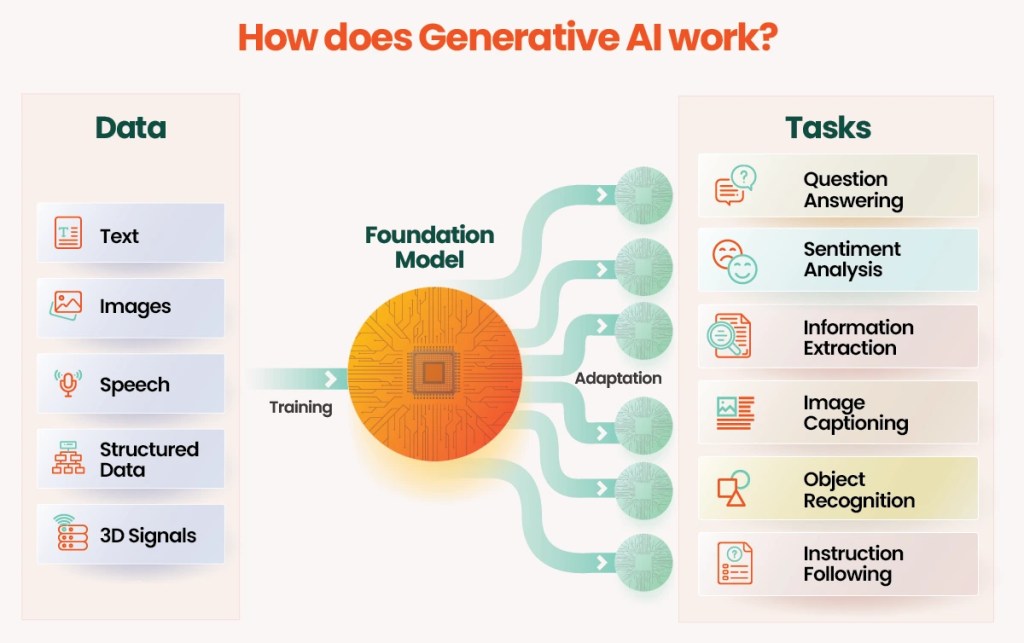
If you’re a visual learner, this diagram summarizes the process beautifully.
Now let’s talk about Assistive AI, a category that’s often overlooked despite many of us having used it for years. Unlike Generative AI, its purpose isn’t to create entirely new work. Instead, it helps people work faster and more efficiently while keeping them firmly in control. It improves existing work by suggesting edits, correcting grammar, organizing information, automating repetitive tasks, and offering recommendations. Think of it as a collaborator rather than a creator. The ideas remain yours. The AI simply helps you refine and execute them more efficiently.
Tools like Grammarly, Hemingway, ProWritingAid, Wordtune, and QuillBot became popular because they handled the tedious parts of writing without taking ownership of the writing itself. They improved grammar, spelling, clarity, sentence flow, paraphrasing, and readability without asking users to hand over the entire creative process. That distinction would become increasingly important once Generative AI entered the picture.

Assistive AI works by responding to human input rather than replacing it. It analyzes what the user has already created, recognizes patterns using machine learning, processes language through Natural Language Processing (NLP), and provides suggestions, corrections, summaries, and recommendations. Unlike Generative AI, it doesn’t aim to produce an entirely new piece of work from a single prompt. Instead, it enhances existing work while leaving the final decisions to the user.
If Generative AI starts with a prompt, Assistive AI starts with your work.
New Technology in the Market: The ChatGPT Revolution
The scene shifts to November 30, 2022.
OpenAI releases ChatGPT, a text-only generative AI chatbot powered by GPT-3.5, as a free research preview. The moment quickly becomes one for the history books. For the first time, powerful conversational AI is accessible to the general public. The Silicon Valley welcomed this innovation and disruption while investors showed increasing interest in AI and investing in AI start ups.
Yet ChatGPT isn’t introduced as the finished future of artificial intelligence. It has no internet access, no image capabilities, no long-term memory between conversations, and its knowledge is limited to 2021. Despite those limitations, its greatest innovation isn’t the technology itself. It’s the accessibility.
For the first time, millions of people can interact with a powerful language model through something as familiar as a chat box. Within five days, ChatGPT reaches one million users. Within two months, it surpasses an estimated 100 million monthly users, becoming the fastest-growing consumer application in history. The breakthrough isn’t just technical. It’s human. Millions of people decide to experiment with a technology that had previously remained out of reach.
Although artificial intelligence had existed for decades, ChatGPT marked a turning point by making powerful conversational AI accessible to the general public. What had largely remained inside research labs, universities, and specialized industries suddenly became available to anyone with an internet connection. As Karen Hao writes in ‘Empire of AI: Inside the reckless race for total domination‘, this wasn’t just another AI system. It was the moment advanced language models entered everyday life.
When ChatGPT launched on November 30, 2022, it was a surprisingly simple product. Powered by GPT-3.5, it was a text-only chatbot with knowledge limited to 2021. It couldn’t browse the web, understand images, remember previous conversations, or interact with external tools. Yet what made it remarkable wasn’t the long list of features we associate with it today. It was the interface. For the first time, millions of people could interact with a powerful language model through something as familiar as a chat box.
Post-Launch Metamorphosis
That, however, was only the beginning.
ChatGPT didn’t remain the same for long. Three major developments transformed it. First, it became capable of accessing more up-to-date information instead of relying entirely on static training data. Second, it became multimodal, allowing people to interact using text, images, voice, and documents rather than text alone. Finally, it became more agentic, evolving from answering individual questions to helping users complete longer, multi-step tasks using connected tools and services.

As these capabilities expanded, ChatGPT evolved from an intriguing research preview into a daily productivity tool for millions of people. Its rapid adoption wasn’t driven by a single breakthrough but by a steady stream of improvements that made it increasingly useful in everyday life.
ChatGPT, however, wasn’t alone for long. Anthropic publicly launched Claude in 2023, Google introduced Bard (later renamed Gemini), and Microsoft integrated Copilot into Bing and Microsoft 365. Within months, generative AI had become a competitive race rather than a single product. People suddenly had multiple tools capable of writing, brainstorming, summarizing, translating, coding, and creating content.
The conversation was no longer about whether people would use generative AI. It became a question of which model they would choose. Regardless of whether someone preferred ChatGPT, Claude, Gemini, or another model, one thing remained constant.
More and more cognitive tasks were gradually being delegated to machines.
As AI became easier to use, people naturally began relying on it for more and more tasks.
The Explosive Adoption Lifecycle

Initially, millions of people gathered around this technology with a mix of curiosity and excitement. Two things made the difference: accessibility and conversation. For the first time, anyone with an internet connection could interact with an AI system that responded in natural language. It wasn’t hidden inside research labs or specialized software. It was available through a simple chat box. That accessibility mattered far more than many people realized.
Generative AI also benefited from something every new technology hopes for: novelty. Students, educators, professionals, businesses, and developers all wanted to experiment with it. Silicon Valley saw both opportunity and disruption as investment in AI accelerated and competitors rushed to respond. For many people, ChatGPT wasn’t simply another software release. It was the first real opportunity to experience technology that had existed mostly in science fiction and research papers.

ChatGPT could perform an extraordinary range of tasks from a single prompt. It could write content from scratch, summarize long documents, explain difficult concepts, translate languages, generate code, and brainstorm ideas. Instead of switching between multiple websites or applications, people suddenly had one conversational interface that could assist with almost everything. The phrase “everything at your fingertips” no longer felt like a metaphor.
In its early months, ChatGPT became a global playground for curiosity. Students, developers, marketers, teachers, writers, and curious internet users all began experimenting with it. They used it to draft emails, essays, cover letters, poems, and stories, debug code, plan holidays, generate recipes, organize everyday tasks, and answer questions that would previously have required multiple searches.
Others experimented simply because they could. They asked it to role-play, tell jokes, imitate famous people, or respond to prompts like “Write a Shakespearean breakup text,” “Explain black holes like I’m five,” “Write Python to sort this list,” or “Plan my Italy trip.” Those first few months felt like a giant global experiment. What began as curiosity gradually evolved into everyday reliance as the technology became more capable and increasingly integrated into people’s daily workflows.

This rapid adoption was driven by two things: convenience and utility. Tasks that once required hours of research, writing, brainstorming, or problem-solving could now be completed in minutes. For many people, AI didn’t replace their work. It reduced the time spent on the repetitive or mentally demanding parts of it. That extra time could then be used for planning, decision-making, collaboration, or other responsibilities. Workdays became more structured, more efficient, and often more productive. People were getting more done in less time.
Before long, ChatGPT evolved from an experimental tool into a daily habit. What began as occasional curiosity gradually became part of everyday workflows. People turned to it whenever they encountered a difficult task, needed a second opinion, or wanted to overcome a creative block. The unspoken understanding became simple: everyone still did the work, but AI had become the assistant many people reached for when they needed help.
That dependence became visible whenever the systems stopped working.
When servers crashed, outages occurred, or demand overwhelmed the platforms, social media filled with the same question:
“Is ChatGPT down?”
News articles appeared. Reddit threads exploded. People refreshed the status page and wondered whether the problem was on their end or affecting everyone else. In just a short time, AI had become so deeply embedded in daily routines that even temporary outages broke the rhythm of work.

The AI tool that was merely a year old, experienced routine crashes due to system overload.
Teachers and professors, on the other hand, began using AI to improve the learning process. They encouraged students to brainstorm with AI but expected them to use their own critical thinking and judgment to develop meaningful analysis. AI could help generate outlines, but students remained responsible for refining, expanding, and supporting their ideas independently. Educators also taught students to identify AI-generated content, recognize biases, spot factual errors, and verify information by cross-referencing it with credible, evidence-based sources.
Beyond teaching technical skills, educators were also responsible for helping students build intellectual independence. They observed how students interacted with AI, distinguishing between technology being used as a learning aid and becoming an intellectual crutch. Reflection exercises encouraged students to think critically about their own work, their use of AI, and the point at which technology should support their thinking rather than replace it.

Outside the classroom, professionals adopted AI for a different reason: speed. Marketers, writers, designers, consultants, analysts, developers, and business teams used it to automate repetitive work, summarize information, brainstorm ideas, analyze data, draft reports, generate marketing copy, and streamline workflows. Used thoughtfully, this was exactly what cognitive offloading was meant to achieve. AI handled repetitive tasks while people focused on strategy, creativity, decision-making, and human judgment.
Then, somewhere along the way, the balance shifted.
People gradually expanded the boundary of what they delegated. Instead of offloading routine tasks, many began offloading the thinking itself. First drafts became final drafts. Brainstorming became content generation. Editing became publishing. The tool designed to support human judgment increasingly began replacing it.
This gradual offloading eventually became dependence. Nobody consciously decided to abandon critical thinking overnight. Instead, people slowly expanded what they delegated. Tasks that once required human judgment became tasks AI completed by default. The question quietly shifted from “How can AI make my work easier?” to “How much of my work can AI do for me?”

The problem was that this shift wasn’t happening in isolation. Millions of people were using the same technology and gradually making similar decisions. Individual habits became collective behavior. That collective behavior created a ripple effect, ushering in an era of AI slop, content fatigue, and a digital landscape increasingly filled with beige ideas.
The Era of AI Slop: Creativity Fades into Beige
It’s 2026, and the consequences are becoming difficult to ignore. The widespread adoption of generative AI has dramatically lowered the cost of producing content at scale. As more people relied on similar models, similar prompts, and similar optimization strategies, digital platforms gradually became saturated with writing that sounded increasingly interchangeable. The corporate world’s New Year’s resolution became a single word: optimization.
Companies wanted better engagement, stronger SEO rankings, greater reach, and more impressions. Faster publishing and greater consistency promised stronger brand awareness and higher productivity. On paper, these were perfectly rational goals. But without clear guardrails and thoughtful implementation, optimization slowly became convergence. Brands weren’t just becoming more efficient. They were beginning to sound the same.

Platforms reflected that shift almost immediately. LinkedIn gradually evolved from a professional networking site into a feed crowded with familiar phrases:
“Thrilled to announce…”
“Here’s what nobody tells you…”
“Three lessons I learned…”
“Comment ‘Productivity’ for my AI prompts…”
“DM me if you want to make your brand stand out…”
Before long, another trend emerged. Feeds became flooded with AI-generated templates promising “20 Claude prompts that will change your workflow,” “The hidden Claude tricks nobody talks about,” or “I just discovered something about Claude and I’m not gatekeeping anymore.” Many creators weren’t even redesigning these templates. They simply regenerated them using tools like Gamma, Canva, Beautiful.ai, Tome, or Figma. The pattern became easy to recognize and increasingly difficult to escape.
The AI slop avalanche lasted for nearly two months. At one point, some users genuinely joked that LinkedIn had either become a paid advertising platform for Claude or that Anthropic had quietly bought shares in the company.

As generative AI became commonplace, LinkedIn and X experienced a surge of polished but increasingly interchangeable content. Users began expressing frustration that their feeds were filled with repetitive hooks, recycled advice, AI-generated commentary, engagement bait, rewritten viral posts, and upcycled summaries. The platforms themselves hadn’t fundamentally changed overnight. The way people used them had.
Not because everyone was cheating.
Because everyone had access to the same kinds of tools.
The same pattern began appearing across the creative industry. Marketing emails, blog introductions, product descriptions, and social media posts started sharing remarkably similar structures, transitions, vocabulary, and conclusions. What began as efficiency gradually became sameness.
As AI made content creation faster and more accessible, many creators adopted it to keep pace with an increasingly competitive digital landscape. Publishing became easier than ever, but so did producing work that sounded almost identical to everyone else’s. Quantity increasingly took priority over originality.
Many creators felt pressured to follow the same approach simply to remain competitive, while audiences became increasingly frustrated with generic, low-effort content. The internet eventually gave this phenomenon a name: AI slop. What began as a tool for improving productivity had, in many cases, evolved into a race to produce more content rather than more meaningful content.
Consumers, however, weren’t passive observers. Across social media, search engines, and creative platforms, they became increasingly skilled at recognizing repetitive, over-optimized content that lacked a distinctive human voice. “AI slop” entered everyday conversations as people questioned feeds filled with templated writing, generic visuals, and recycled ideas. The problem wasn’t simply that AI was being used. It was that much of the content felt as though it could have been created by almost anyone using the same model and similar prompts. As originality became harder to find, authenticity became more valuable.
Markets eventually responded. Search engines, platforms, and AI companies increasingly rewarded originality, transparency, and human oversight while looking for ways to distinguish genuinely valuable work from large volumes of generic AI-generated content. The backlash reflected something much bigger than dissatisfaction with AI. Audiences had started expecting originality again.
That shift laid the foundation for what many marketers and creators now call the Bland Tax.
The Tax of the Hour: If Your Content Has No Spice, You Will Pay the Price
The problem wasn’t limited to individual creators. By 2025, it had reached the corporate world.
That year, Wynter surveyed marketing leaders at B2B SaaS companies with more than $50 million in annual recurring revenue (ARR). An astonishing 94% admitted that their brands sounded almost identical to their competitors. The messaging was similar. The frameworks were similar. The proof points were similar. Even the content strategies had begun to converge. Years spent building a distinctive brand voice had, in many cases, dissolved into a single, predictable tone.
By this point, the problem had become impossible to ignore. Everyone could see it. Nobody had a name for it. That changed on April 21, 2026.

At the Adobe Summit, Andrew Warden, CEO of Semrush, introduced the term “Bland Tax.“ He described it as the invisible penalty brands pay when AI search can no longer distinguish them from their competitors. That penalty isn’t measured in money. It’s measured in visibility.
Whenever a potential customer asks an AI system for recommendations in your category, every brand that sounds the same becomes easier to ignore. Many founders still think this is simply a branding problem. In the age of AI search, it’s much bigger than that. It’s a discoverability problem.
A brand doesn’t slowly fade into the background. It simply disappears.
How Does the Bland Tax Work?

Traditional search engines return a list of websites. AI search works differently. Instead of directing you to one source, it reads information from many sources and synthesizes it into a single answer. That creates a new challenge for brands.
If several companies use the same language, ideas, and messaging, AI may blend them together instead of recognizing who said it first. Your research may help shape the answer, but your brand may never be mentioned. You’re no longer competing with a single competitor.
You’re competing with everyone who sounds like you.
In a world where AI summarizes information, sounding different isn’t just good branding. It’s how people remember who you are.
This isn’t simply a concern raised by marketers. Researchers have observed the same pattern. Multiple studies have found that while AI helps individuals generate ideas more quickly, widespread reliance on the same models can make groups produce increasingly similar outputs. Researchers describe this broader phenomenon as algorithmic monoculture: a gradual convergence toward similar ways of writing, thinking, and presenting information as millions of people rely on the same systems.
A 2024 study illustrates the effect clearly. Participants using ChatGPT often felt more creative as individuals. Yet when researchers compared everyone’s work together, the ideas became noticeably more alike. Each participant believed they were producing something original. Collectively, however, their work had quietly converged.
Perhaps the real cost of the Bland Tax was never lower rankings or reduced visibility. It was discovering that, in our rush to save time, many of us had quietly outsourced the very thing that made our work worth reading in the first place:
Our judgment. AI made creation easier.
The responsibility of deciding what deserves to be created never stopped being ours. Because distinction has never come from the tool.
It has always come from the person using it.
Citations and References:
1. Assistive AI vs Generative AI: What’s the Difference? – Cipher Nutz
2. LLM vs Generative AI: Comparing Models, Memory, and Architecture – Cognee
3. Explained: Neural networks – MIT News
4. What is artificial intelligence (AI)? – IBM
5. Introduction: Why Understanding Generative AI Matters to Digital Leaders – Qodequay Technologies
6. OpenAI’s dominance is unlike anything Silicon Valley has ever seen – CNBC
Leave a Reply