How a football ritual rooted in centuries of maritime culture became an unexpected lesson in nation branding, community, and the power of authentic traditions.
The FIFA World Cup 2026 has genuinely outdone itself in bringing the global community together. The warmth, camaraderie and sportsmanship has travelled in every video that surfaces online every day. People of every country invited, have been coming together in human spirit and in a way that the world never anticipated. There have been multiple comments by the online community on Instagram and TikTok videos about how people are watching ‘the world heal’ in real time, given the current geo-political and social landscape.
Everyone is immersing themselves together in a giant pot of melting cultures without thinking about countries and borders. It speaks volumes about what actually matters to people deep down.

Some countries did leave a bigger and more significant impact than the others in the spirit of sharing their rituals and traditions in a global arena. But Norway left behind their simple yet deeply powerful ritual – the Viking-inspired rowing ritual. Already well-known for their fjords, natural beauty, thriving political system and welcoming culture, this time Norwegians have taken the world by storm with their modern-age football tradition.
The Originator of the Viking Rowing Tradition.

So who invented this ritual, and why did it become a symbol of a country?
Ole Froystad, (often called “Mr. Row”) is a 39-year-old primary school teacher from a tiny island on Norway’s west coast. He is also a leader within ‘Oljeberget‘ (“Oil Mountain”), Norway’s primary national team supporters’ club. He claims to have started the tradition when he got the idea while watching a domestic Rosenborg BK match. His ears caught the crowd’s chanting sound of “Ro-Sen-Borg”, especially the opening syllable “Ro,” which means “row” in Norwegian. Then he built a synchronized rowing motion around it. The move has acquired its own soundtrack, called “Viking blood”, which has climbed to first place on Norway’s Spotify chart.
ESPN published an excellent feature tracing the origins of the Viking Row through conversations with its creator, Ole Frøystad. Rather than retelling every detail of that story, what interests me is what happened after the chant left the drawing board and entered the world’s biggest football stage.
In retrospect, his commitment to the tradition made it go viral. He made the extra effort to produce instructional social media videos for fans, showing them exactly how to execute the action. The video ended up on local news channels. He said, “I properly explained, ‘OK, put your hands forward, bend forward. If you don’t use your back when you row, it’s not going to be visible. It’s just going to be audible.”
He wasn’t prepared for what happened next. “After that game when I had a video of it, I’m like, ‘Yeah, maybe I should just post this. That’d be fun on my account,” Frøystad said. “I didn’t have a lot of followers. It’s just a regular Instagram account. So I posted that video, and it took off. Now it has 38 million views and almost 3 million likes. This is before the World Cup started. That’s when I realized: This is going to be insane when we go to the World Cup.”
Frøystad elaborated further in an interview: “A thousand years ago, the Vikings rowed. They took in their sails and oars to get to shore. And they did that right before battle. It’s about rowing for the team, making sure they feel good on the pitch.” – Mashable.
In 2025, he introduced this routine during a friendly match against Switzerland and it gained more momentum against Sweden before going global in 2026.
The gesture, meant to symbolize a Viking longship, has become the defining ritual of Norway’s storming start to their first men’s World Cup since 1998.
The story’s heartbeat is that the tradition’s creator isn’t a big name or a branding consultant. It isn’t a government tourism board or advertising agency either. It is definitely not FIFA.
It’s a simple primary school teacher and a leader of a national team supporters’ club, who transformed something local into a global phenomenon. Sometimes the most powerful ideas come from humble origins.
How the Tradition Works

The routine is highly synchronized and serves as a rallying cry for the players.
- The Signal: A capo (fan leader) blows a Viking horn to gather the crowd and signal the start of the routine.
- The Rhythm: Supporters sit shoulder-to-shoulder in long lines, mimicking a crew powering a ship. Backed by the heavy strike of a bass drum, the crowd pulls imaginary oars and shouts “Ro!”.
- The Escalation: The ritual begins at a slow, heavy pace and gradually builds in speed and volume as more fans join in unison.
Borrowing Semblance from the Viking-Rowing Tradition.

The rowing tradition is not rooted in an ancient practice. But it does borrow a little from the simple yet historically significant Viking imagery dating back to 793 to 1066 AD. During this era, the image of Viking rowers in a longboat, was one of the most recognizable symbols connected with Norway and wider Scandinavian culture. It’s heavily inspired by their heritage and maritime history.
Norway is one of the countries most closely associated with the Viking Age, when when Scandinavian seafarers built up wide networks of travel, trade and exploration. These were built for flexibility, endurance and speed. Muscle power as manual strength, was needed to move the oars when needed and sails were used when the winds allowed. This form of transport carried people, animals and all kinds of goods up along the coast, across rivers and seas to faraway countries.
The age is often traced back to the raid on Lindisfarne Monastery in England in 793. For Norwegians, however, the Viking story is not only linked to raids, but also to shipbuilding, long-distance navigation and expansion across the North Atlantic, including Iceland, Greenland and Vinland, the Norse name connected with early voyages to North America.
Although the Viking Age is usually seen as ending after the Battle of Stamford Bridge in 1066, its maritime spirit remains an important part of Norway’s cultural identity. The image of the Viking in Norway today is closely tied to endurance, freedom and survival in harsh natural conditions. That is why the rowing gesture is more than a fan performance; it echoed a historical symbol that many Norwegians still recognize as part of their national story.
The History
Rowing has a very integral role in Norway’s history. The very act of rowing was actually instrumental in helping Leif Erikson accidentally discover North America in 1000 AD. He was a Norse explorer, who flourished during the 11th century and accomplished this feat. He was also the first European known widely, to have found the land known as Newfoundland in Canada today.

In fact, an anonymous Norwegian Redditor confirmed the narrative and said, “Yeees we did row (Ro) as Vikings, but this isn’t really something we do outside of football.. it’s not really a tradition, but Vikings did chant while rowing, to keep rhythm. Also it must have been quite intimidating seeing a ship full of Vikings with long beards, shields, swords and axes coming towards you shouting “Ro, ro, ro!” (row, row, row) faster and faster as they speed up and prepare for battle.
But more often than not, Vikings relied on the element of surprise and cunning tactics.”
Rowing beyond Historical Timelines.
Even centuries after the Viking Age, rowing stays a part of daily Norwegian life. Fishermen travel in open boats to various parts of Europe. For more than thousands of years, fishermen sailed and rowed in open boats, to Lofoten in winter, where they caught skrei. It’s a cod fish that migrates to the shores of Lofoten, Vesterålen, and the rest of Northern Norway, from February to April. In northern Norway, the Lofoten fishery became legendary.

The people depended on the sea for food, income and connection. Even though the journeys were cold, hard and dangerous. The coastal communities, sea trade routes, seasonal rhythms and Norwegian identity revolved around the fishing industry. In reality, the skrei fish built Norway and discovered beautiful trade cities like Trondheim and Bergen.
Rowing was work and survival. It was about taking part in one of the great shared traditions of the Norwegian coast.
Rowing Takes Over at FIFA World Cup 2026.
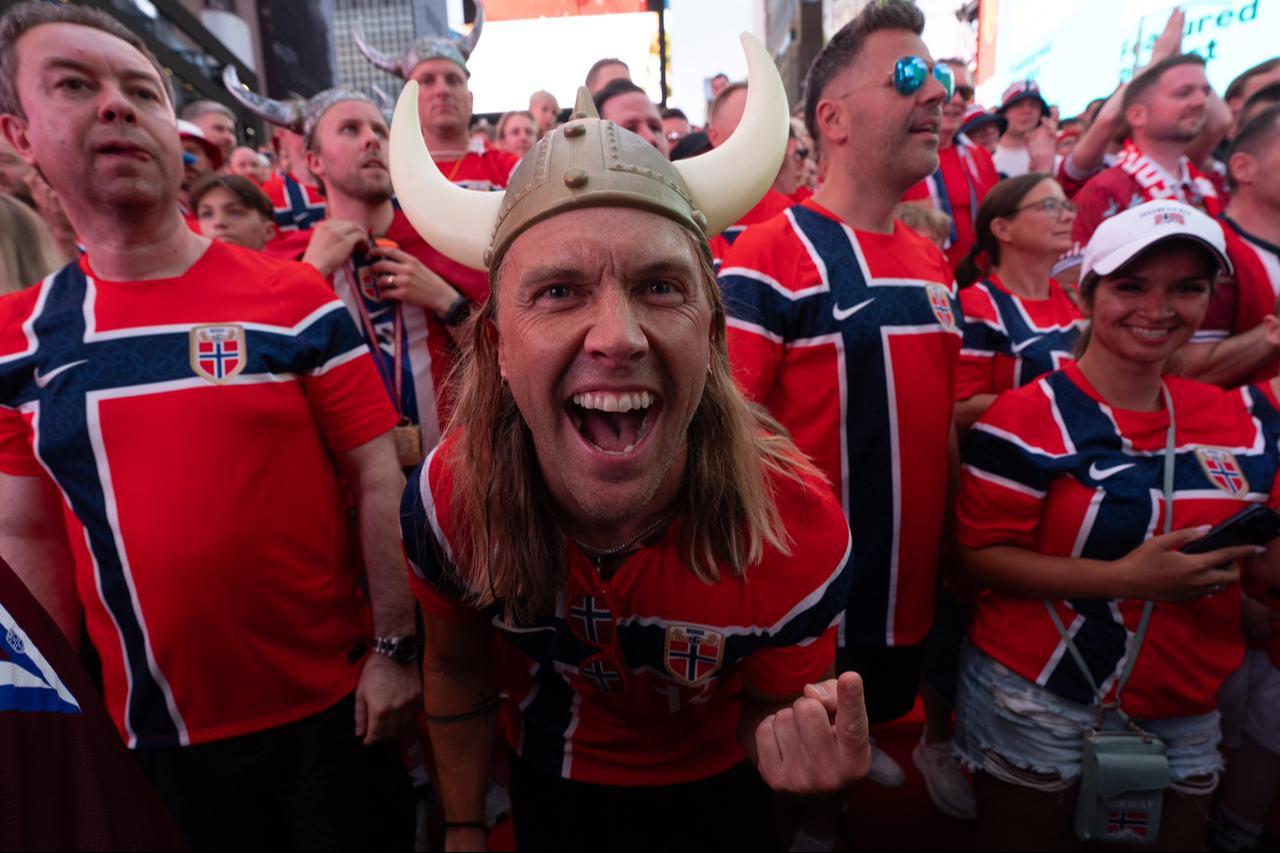
A simple tradition of celebration turned into a travelling cultural boat that sailed across borders. The Norway team took a win against Senegal on June 23, 2026 at the New York-New Jersey stadium. Norway fans and supporters took to the streets at home and performed the ‘Viking Row’ to cheer this victory.

In New York, they gathered in a crowd to ‘row’ at the Times Square, MetLife Stadium, subways and Citi Field. Then they showed up on the escalators at downtown Boston, much to everyone’s amusement.


When the Team players came Together for Norway.
The celebration made Norway’s campaign more human and relatable; a story that has been written into modern history and sports marketing case studies. When the team won against Senegal and won a place in the knockout stage, the players joined the fans. Once the team’s star striker Erling Haaland, team captain Martin Ødegaard and the rest of the squad joined in, the celebration became part of the tournament’s wider language. Martin led the celebration rhythm by banging the drum.
“We knew this whole thing could become big for Norway because we have Haaland,” said Ragnhild Ask Connell, director of communications at the Norwegian Football Federation (NFF).
The Psychology of Traditions and Rituals in Sports.
The ‘Viking Row’ has become integral to Norway’s campaign; a campaign that has become a national moment. So what’s so special about this tradition that has millions enjoying and watching it at the FIFA World Cup 2026?
Its simplicity is its biggest appeal. A few people start it and within seconds, an entire stand can look like it’s pulling in the same direction. Its popularity has given the Norwegians a distinctive sense of national and cultural identity. The emotional branding lies in the fact that they can connect it with history and resonate with it.

It’s recognisable, repeatable and easy for all the viewers to understand. A significant reason for its virality lies in its visual appeal. It looks great on camera. Most modern sports rituals and traditions grow on people by spreading on social media. It’s playful and draws on Viking imagery, but feels more like a fun football chant than a history lesson. Its charm is based on the fact that it’s a modern idea, not something passed down from history. It’s not trying to be ceremonial. Instead, it’s symbolic of a national image for Norway because it’s collective, easy, loud and repeatable.
Terje Leiren, a retired professor from the Department of Scandinavian Studies at the University of Washington in Seattle, gives more context. He was knighted by Norwegian king Harald V for his services to researching Scandinavian history and the Vikings. “Viking, the word itself, it’s a verb that becomes a noun because it is the act of going away, leaving and to go raiding was to be a Viking,” Leiren said. “Those who did that became known as Vikings.” Leiren says the Viking spirit symbolizes Norway’s World Cup team — a side that has left its homeland in search of glory (albeit with far less violence) elsewhere.
“It’s sort of a metaphor, that’s sort of what they’re doing,” Leiren said.
Subsequent research on synchronized movement — drumming, clapping, marching, chanting — has consistently found the same thing: it increases feelings of social bonding, trust, and group identity in ways that individual action does not. Moving in time with other people temporarily dissolves the boundary between self and group. You stop being individuals who happen to be next to each other, and start being something more unified.
One Tradition. Unexpected Critiques.
The ‘Viking Row’ has people talking and approach the tradition from various perspectives. While it has some critiques, it has managed to survive the viral moment and create the collective national resonance for people.
Torstein Hamran, who is a museum coordinator is among the leaders of the Norwegian supporters group. He’s the person banging the drum for the row at games. He said, “It worked out OK,” Hamran said. “It got some critiques that it looked silly.”
Some commentators from Norway were stiff about the demonstration and created backlash against this tradition. They say that the Vikings, for all their looting and pillaging from as early as 800 A.D., are not figures to be idolized. They’re apprehensive that this act might romanticize the people who sometimes ‘rowed and travelled for a different purpose.’ They caution that people shouldn’t aspire to these early Norsemen due to their acts of violence like raids, pillaging and invasion.
Terje Leiren, a retired professor from the University of Washington said that the tradition definitely plays on some stereotypes about the Viking violence. But in this context, it’s only trying to symbolize the Norway World Cup team.
Not everyone is excited about the modern development. While Ødegaard and Haaland have been keen to talk it up, Norway manager Ståle Solbakken has taken a different tone. “It’s fun for the fans,” Solbakken said after the win against Senegal. “We will not be rowing after the World Cup, but this can be a gimmick during the tournament.”
The speaker of Norway’s parliament, Masud Gharahkhani, reached out to the organizers of the row to discuss the meaning behind it. Gharahkhani said the message was clear: “We are doing it for peace. We are doing it for love and to show our support for the football team, which we are really proud of.”
Their Swedish counterparts weren’t happy about it. Sweden defender Gustaf Lagerbielke voiced his frustration, telling reporters: “I am never going to do it. We just sigh. Perhaps mostly at the TV crew who choose to zoom in on it every single time. It is very similar to the Icelandic volcano, after all. But, whatever floats your boat.”
Teammate Elliot Stroud echoed this sentiment, adding: “It is probably starting to get a bit overused. It feels like they run it every time they get the chance. But it does work well for them, after all.”
Danish journalist Johnny Wojciech Kokborg, writing in the tabloid B.T., described the Norwegian euphoria as “bordering on Nordic adult bullying.” He added sadly, “The Norwegians are currently experiencing the party of their lives. The fact is—unfortunately—that the Norwegians could end up hurting a lot of teams. But most of all, it hurts us Danes to admit that we are no longer the best in the Nordic region.
Norwegian journalist Marcus Sletvold criticized the images as “nationalistic and exclusionary.” Jane Haug Sætre, a Norwegian researcher and scholar, told local media Klassekampen that Norway’s World Cup uniforms “could appear overly masculine and right-wing extremist.”
Emil Anners Lappen, a 24-year-old forestry manager, became briefly famous during Norway’s win over Senegal after television cameras caught him sitting still while Norwegian supporters around him rowed.
“I did not think at the time that I would get so much attention for sitting still,” he told the FT. “It is very Norwegian to do what everyone else is doing and stand out as little as possible. When someone stands out even a little, everyone goes completely crazy.”
The reaction could be seen as a classic example of Janteloven, the Scandinavian code that polices those who stand apart from the group, said Janne Stigen Drangsholt, a Norwegian academic and cultural commentator.
‘Viking Row’ in the Norway Parliament.
The World Cup fever found its way into the Norwegian Parliament, where elected representatives got into the team spirit and performed a ‘Viking Row’ to show support to the players. Thursday’s parliamentary session was briefly interrupted when the speaker suggested that the members repeat the fans’ rowing action to show the nation’s support for the ongoing campaign, and the parliamentarians responded enthusiastically in a cross-party display of unity.

What Drew a Dove Partnership into the Picture?
The World Cup 2026, found a sponsorship partner in Dove, who utilized and amplified the energy around the ‘Viking Row’ to spread the message of inclusivity and self-confidence in sports. The brand sponsored fans and influencer at important matches and highlighted the tournament’s unifying spirit.
Dove Men+Care sponsored fan experiences and hosted content creators at crucial matches, such as the Norway vs. Senegal game at MetLife Stadium. They documented their experiences on their official channel to bring them closer to the brand message and witness the magic of the ‘Viking Row’.
The viral moment was utilized by the brand’s mission to encourage body positivity for girls in sports and give a global platform to underrepresented girls and women in games. For this purpose, it teamed up with the history-making referee Tori Penso and the Body Confident Sport program.
So, how does a country become memorable?
The ‘Viking Row’ reminds us that the strongest brands are rarely built from visibility alone. They are built from meaning. Before it became a sponsorship, a social media phenomenon or a case study in nation branding, it was simply a community choosing to row together. Everything else followed.
Sources and References:
1. How Norway’s ‘Viking Row’ was made – ESPN.
2. World Cup 2026: Norway goes viral with Viking-inspired rowing ritual – Turkiye Today.
3. What is the Viking Row? Norway’s viral World Cup celebration explained – The National News
4. Leif Erikson’s Biography – Britannica.
5. Norway Viking Row: Know Origin Of Chant – Mashable
6. Norway’s viral tribute – The Norwegian Viking Row – Visit Norway
7. The Viking Row: Why Norway’s Viral Football Celebration Feels So Ancient – Runes to One Norway
Leave a Reply